Seller Credit vs Price Reduction
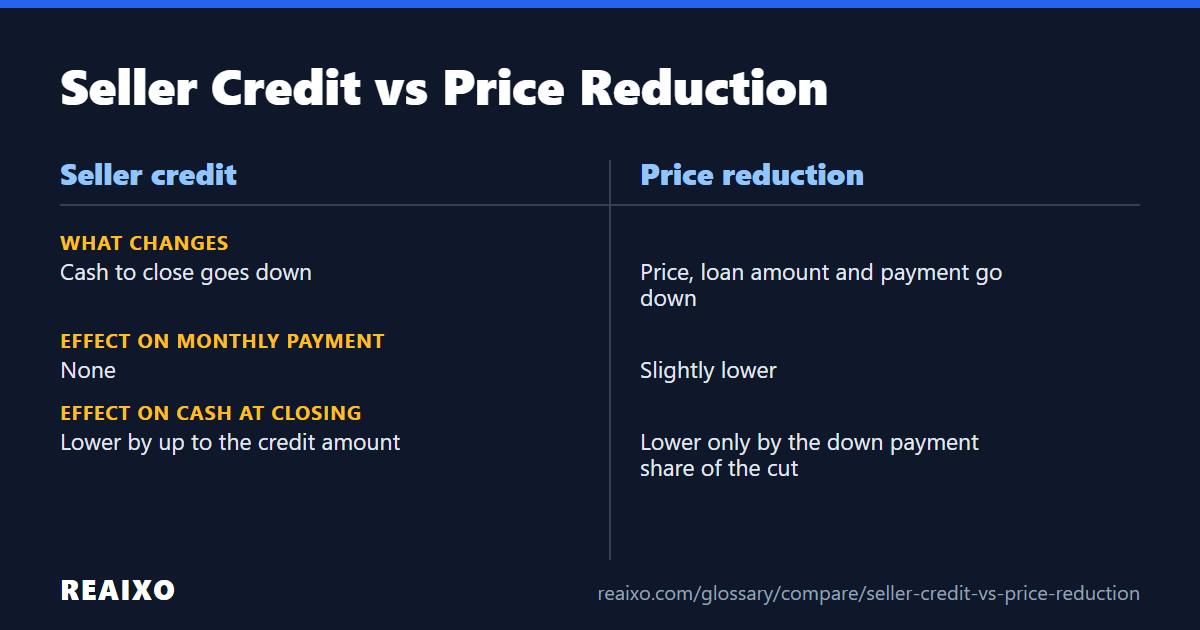
A seller credit (concession) pays part of your closing costs, so it reduces the cash you need at closing but leaves the price, loan and payment unchanged. A price reduction of the same amount lowers the loan and the monthly payment slightly, but saves little cash upfront. Cash-short buyers usually gain more from a credit; buyers with ample cash may prefer the lower price.
Seller credit vs Price reduction side by side
| Seller credit | Price reduction | |
|---|---|---|
| What changes | Cash to close goes down | Price, loan amount and payment go down |
| Effect on monthly payment | None | Slightly lower |
| Effect on cash at closing | Lower by up to the credit amount | Lower only by the down payment share of the cut |
| Limits | Capped by the loan program and by your actual closing costs | No program cap |
| Effect on the property's recorded sale price | None - the price stays higher | Lower sale price |
| Seller's net | About the same as an equal price cut | About the same as an equal credit |
Full definitions: Seller Concession.
When each one helps more
Ask for a credit when cash is the constraint: it can cover closing costs and prepaid items you would otherwise pay out of savings, leaving reserves for moving and repairs.
Ask for a price reduction when you have the cash and plan to stay a long time, when the appraisal came in low (a lower price also fixes the appraisal gap), or when the credit would exceed what your loan program allows.
Limits that decide the answer
Loan programs cap how much a seller or other interested party can contribute. For conventional loans sold to Fannie Mae, the cap depends on occupancy and loan-to-value - for a principal residence, from 3% of the price above 90% LTV up to 9% at 75% LTV or less, and 2% on investment properties. FHA and VA set their own limits.
A credit can only pay real closing costs and prepaids; it generally cannot be taken as cash or used toward the down payment. Any amount above your actual costs is lost unless the price is adjusted instead.
Cash to close: from total owed to the wire amount
Cash to close is what you bring on closing day: everything you owe, less money already paid and credits from the seller or lender.
- Total owed
- $52,000
- Down payment, costs and prepaids
- Cash to close
- $45,000
- Usually sent by wire
Show the numbers as a table
| Step | Amount |
|---|---|
| Down payment | +$40,000 |
| Closing costs | +$9,000 |
| Prepaids and escrow | +$3,000 |
| Earnest money already paid | −$5,000 |
| Seller and lender credits | −$2,000 |
| Cash to close | $45,000 |
Formula
Cash to close = Down payment + Closing costs + Prepaids − Earnest money − CreditsAssumptions
- Credits can pay closing costs and prepaids, not the down payment; lenders cap them.
- Your Closing Disclosure states the exact figure at least three business days before closing.
- Confirm wire instructions by phone with your closing agent - wire fraud is common.
Worked example: $6,000 either way
A $6,000 seller concession versus a $6,000 price cut
Illustrative example - round numbers, not current market data. Calculated with Reaixo's calculator engines.
Assumptions
- Price
- $400,000
- Down payment
- 10%
- Rate
- 6.75%, 30 years
- Buyer closing costs
- 3% of price
- Property tax
- 1.2% of price a year
| Step | Calculation | Result |
|---|---|---|
| 1. Fannie Mae limit at 90% LTV (6% of price) | $400,000 × 6% | $24,000 |
| 2. Cash to close with the concession | down payment + closing costs − credit | $46,000 |
| 3. Cash to close with the price cut | down payment + closing costs | $51,220 |
| 4. Monthly payment with the concession | principal, interest and tax | $2,734.95 |
| 5. Monthly payment with the price cut | principal, interest and tax | $2,693.93 |
Cash saved at closing by the concession: $5,220. The concession saves the buyer $5,220 of cash now; the price cut saves about $41 a month instead. Short on cash? The concession usually helps more. The seller nets about the same either way.
What this calculation leaves out
- A concession can only pay allowable closing costs and prepaids, never the down payment, and not more than the costs.
- Limits differ for FHA, VA and investment properties.
Common misconceptions
- A credit is free money. It is part of the deal's economics; the seller nets about the same as with an equal price cut.
- Any credit amount works. It is capped by the loan program and by your actual closing costs.
- A price cut always helps more. It saves only a small amount each month and little cash at closing.
Frequently asked questions
Is a seller credit better than a lower price?
For most cash-short buyers, yes, because it reduces cash at closing dollar for dollar. Buyers with plenty of cash who will keep the loan for many years may prefer the lower price.
Can a seller credit exceed my closing costs?
No. Credits can only cover actual closing costs and prepaids within the program's limit; any excess is typically lost unless the price is lowered instead.
Does a seller credit affect the appraisal?
The appraiser considers concessions when comparing sales, and the home must still appraise at the contract price. A credit does not fix a low appraisal; a price reduction does.
Calculators and guides
Recommended next step
See cash to close, payment and total cost for both options with your numbers.
Compare a credit and a price cut →Sources and review
- Selling Guide B3-4.1-02, Interested Party Contributions (IPCs), Fannie Mae. Supports: Fannie Mae interested party contribution limits by occupancy and loan-to-value.
Where this applies: United States. Federal disclosure rules (TILA/Regulation Z, RESPA) apply nationwide; loan-program limits are set by Fannie Mae, Freddie Mac, FHA, VA or the individual lender.
Last reviewed: · Updated:
Worked examples use illustrative round numbers, not current market data. Rates, limits and program rules change - confirm current figures with your lender or a qualified professional.
General educational information, not financial, legal, tax or real estate advice. Rules vary by loan program, transaction and location - verify important decisions with qualified professionals.