Pre-Approval vs Clear to Close
Pre-approval comes at the start: a lender reviews your income, assets and credit and says how much it is likely to lend, before you have a property. Clear to close comes at the end: underwriting has verified the specific home, the appraisal, insurance and every condition of approval, and the lender is ready to fund. Between the two, the loan can still change or fall through.
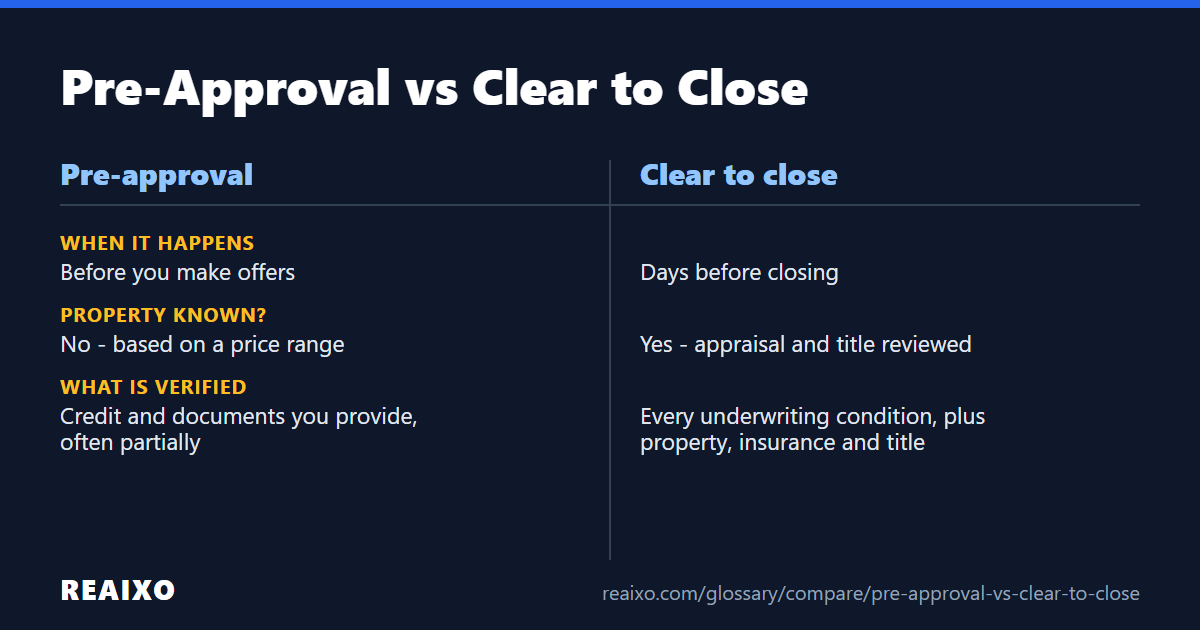
Pre-approval vs Clear to close side by side
| Pre-approval | Clear to close | |
|---|---|---|
| When it happens | Before you make offers | Days before closing |
| Property known? | No - based on a price range | Yes - appraisal and title reviewed |
| What is verified | Credit and documents you provide, often partially | Every underwriting condition, plus property, insurance and title |
| Commitment | Conditional; not a promise to lend | Final approval, subject to no changes before funding |
| What you use it for | Setting a budget and strengthening offers | Scheduling closing and arranging cash to close |
| Can still fall through? | Yes - many conditions remain | Rarely, but new debt or a job change can still stop it |
Full definitions: Pre-Approval, Clear to Close.
What each stage means for you
Get pre-approved before you shop so you know your price range and can show sellers you are a credible buyer. Treat the amount as a ceiling, not a target - your comfortable payment may be lower.
Wait for clear to close before booking movers, giving notice on a lease or wiring money. Until then, underwriting can still ask for documents or change terms.
What changes between them
- The property: the appraisal must support the price, and title must be clear.
- Your file: pay stubs, bank statements and explanations for large deposits are updated and verified.
- The numbers: your Loan Estimate becomes a Closing Disclosure with the final cash to close.
Worked example: what you bring once you are clear to close
Cash to close on a $400,000 purchase
Illustrative example - round numbers, not current market data. Calculated with Reaixo's calculator engines.
Assumptions
- Down payment (10%)
- $40,000
- Closing costs
- $9,000
- Prepaids and initial escrow
- $3,000
- Earnest money already paid
- $5,000
- Seller credit
- $2,000
| Step | Calculation | Result |
|---|---|---|
| 1. Total owed | $40,000 + $9,000 + $3,000 | $52,000 |
| 2. Less money already paid and credits | $5,000 + $2,000 | $7,000 |
| 3. Cash to close | $52,000 − $7,000 | $45,000 |
Cash to close: $45,000. The buyer must wire or bring $45,000 - not just the $40,000 down payment. Keep separate reserves for moving and the first repairs.
What this calculation leaves out
- Use the "Cash to Close" figure on your Closing Disclosure; this example is illustrative.
- Confirm wiring instructions by phone with your settlement agent using a number you already know - never one from an email.
Common misconceptions
- Pre-approval guarantees the loan. It is conditional on verification, the property and your finances not changing.
- Clear to close means you can use credit again. Lenders may re-check credit and employment right before funding.
- Pre-qualification and pre-approval are the same. Pre-qualification is usually a lighter estimate.
Frequently asked questions
How long does it take to go from pre-approval to clear to close?
It varies with the lender and your file. Once you are under contract, underwriting often takes a few weeks.
Can I be denied after pre-approval?
Yes. A low appraisal, a change in income or credit, or documents that do not verify can stop the loan.
Does clear to close mean I will close on time?
Usually, yes. Remaining steps such as the Closing Disclosure timing and title work still need to line up.
Calculators and guides
Recommended next step
Know the final amount before the lender issues clear to close.
Estimate your cash to close →Sources and review
No regulator defines these terms; the page follows common industry practice and labels rules of thumb as such.
Where this applies: United States. Underwriting conditions are set by each lender and loan program; federal disclosure timing rules apply to the Closing Disclosure.
Last reviewed: · Updated:
Worked examples use illustrative round numbers, not current market data. Rates, limits and program rules change - confirm current figures with your lender or a qualified professional.
General educational information, not financial, legal, tax or real estate advice. Rules vary by loan program, transaction and location - verify important decisions with qualified professionals.