Gross Lease vs Net (NNN) Lease
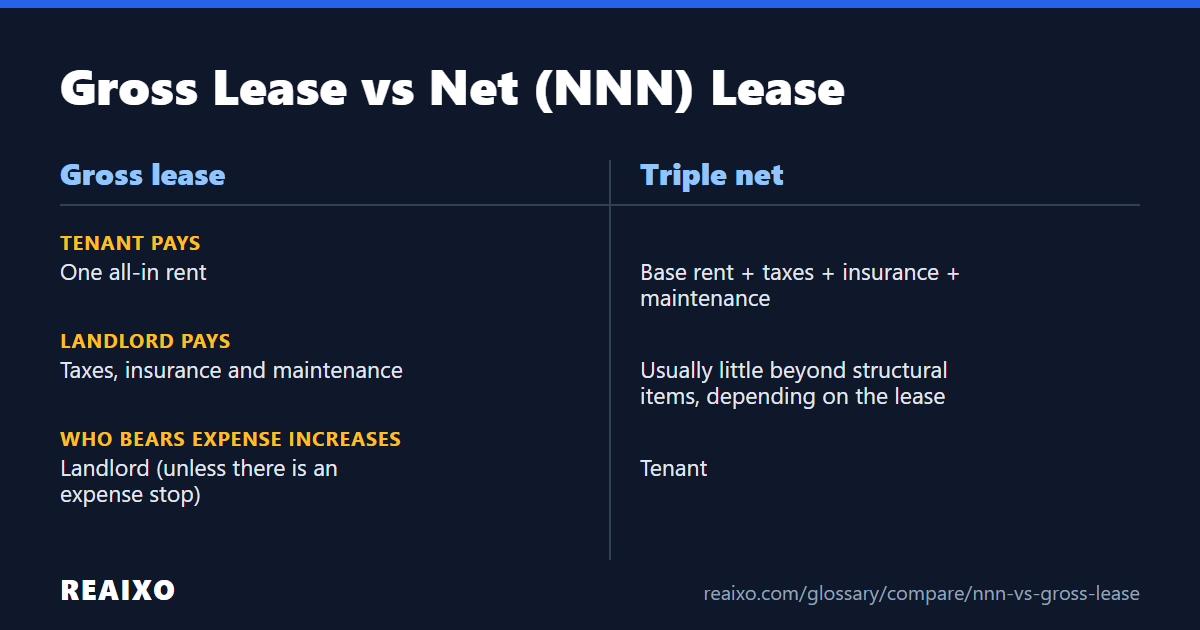
The difference is who pays the property's operating costs. In a gross lease the tenant pays one rent and the landlord covers property taxes, insurance and maintenance out of it, so the landlord carries the risk of those costs rising. In a triple net (NNN) lease the tenant pays a lower base rent plus all three, so the landlord's income is steadier and the tenant carries the risk.
Gross lease vs Triple net side by side
| Gross lease | Triple net | |
|---|---|---|
| Tenant pays | One all-in rent | Base rent + taxes + insurance + maintenance |
| Landlord pays | Taxes, insurance and maintenance | Usually little beyond structural items, depending on the lease |
| Who bears expense increases | Landlord (unless there is an expense stop) | Tenant |
| Rent per square foot | Higher, because costs are built in | Lower base rent |
| Landlord NOI | Varies with expenses | Close to the base rent and more predictable |
| Common for | Apartments, small offices, multi-tenant buildings | Single-tenant retail, restaurants, industrial |
Full definitions: Gross Lease, Triple Net Lease.
When each one fits
Gross leases suit tenants who want a single, predictable payment and landlords who can manage and budget operating costs across many tenants. Residential leases are effectively gross.
Triple net leases suit landlords who want income that behaves like a bond and tenants who want control over their space and costs. Long single-tenant NNN leases to strong tenants are popular with income-focused investors.
Many leases sit in between - a modified gross lease, or a gross lease with an expense stop - so read the expense clauses rather than relying on the label.
How NOI and comparisons differ
- Compare gross and net rents only after converting them: net rent + the tenant's share of operating costs ≈ gross rent.
- For the landlord, NOI under a gross lease is rent minus operating costs; under NNN it is close to base rent, less any costs the landlord still bears and vacancy.
- Cap rates on NNN properties apply to steadier NOI, which is one reason they are often lower for strong tenants.
Worked example
The same building leased gross and triple net
Illustrative example - round numbers, not current market data. Calculated with Reaixo's calculator engines.
Assumptions
- Space
- 10,000 sq ft
- Gross lease rent
- $30 per sq ft a year
- Triple net base rent
- $21 per sq ft a year
- Taxes, insurance and common-area maintenance
- $40,000 + $15,000 + $35,000 = $90,000 a year
- Expense increase in year 2
- 10%
| Step | Calculation | Result |
|---|---|---|
| 1. Gross lease: landlord NOI, year 1 | $300,000 − $90,000 | $210,000 |
| 2. Triple net: landlord NOI, year 1 | 10,000 × $21 | $210,000 |
| 3. Tenant cost under either lease, year 1 | $210,000 + $90,000 | $300,000 |
| 4. Gross lease: landlord NOI, year 2 | $300,000 − $99,000 | $201,000 |
| 5. Triple net: tenant cost, year 2 | $210,000 + $99,000 | $309,000 |
Who absorbs a 10% expense increase: Gross: landlord · NNN: tenant. In year 1 both leases cost the tenant $300,000 and give the landlord $210,000 of NOI. When expenses rise 10%, the gross-lease landlord's NOI drops to $201,000, while under the triple net lease the tenant pays the extra $9,000.
What this calculation leaves out
- Many gross leases include an expense stop or base-year clause that passes increases above a set level to the tenant.
- Lease terms decide who pays what; labels like "modified gross" or "NNN" are not standardized.
Common misconceptions
- A lower NNN rent is cheaper for the tenant. Add the pass-through costs before comparing.
- NNN landlords have no costs. Leases often leave the roof, structure or vacancy costs with the landlord.
- Lease labels are standard. "NNN", "modified gross" and "absolute net" are defined by each lease.
Frequently asked questions
Is a triple net lease better for the landlord?
Usually, for predictability. The tenant absorbs expense increases, but the base rent is lower and the landlord depends on one tenant paying everything.
What does NNN stand for?
It stands for net-net-net: the tenant pays the three nets of property taxes, insurance and maintenance on top of base rent.
What is a modified gross lease?
It is a lease that splits operating costs between landlord and tenant, for example with the tenant paying utilities or increases above a base year.
Calculators and guides
Recommended next step
Enter the expenses the landlord pays to see the NOI each lease produces.
Model NOI under your lease terms →Sources and review
No regulator defines these terms; the page follows common industry practice and labels rules of thumb as such.
Where this applies: United States. Lease terms are contractual; state and local law can affect who may be charged for certain costs.
Last reviewed: · Updated:
Worked examples use illustrative round numbers, not current market data. Rates, limits and program rules change - confirm current figures with your lender or a qualified professional.
General educational information, not financial, legal, tax or real estate advice. Rules vary by loan program, transaction and location - verify important decisions with qualified professionals.