Loaded Cap Rate vs Implied Cap Rate
Both start from an ordinary cap rate, but they adjust it for different jobs. A loaded cap rate adds the effective property tax rate so an appraiser can value a building without first knowing the tax bill, which depends on that value. An implied cap rate divides NOI by a price - a REIT's market value or an asking price - to reveal the yield that price assumes.
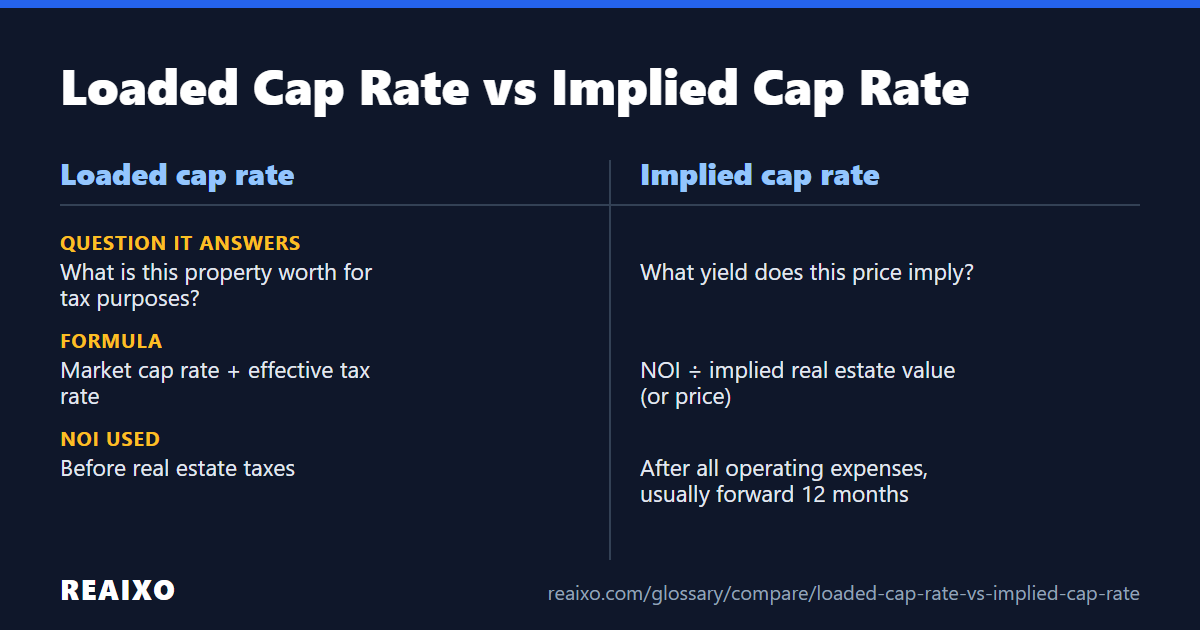
Loaded cap rate vs Implied cap rate side by side
| Loaded cap rate | Implied cap rate | |
|---|---|---|
| Question it answers | What is this property worth for tax purposes? | What yield does this price imply? |
| Formula | Market cap rate + effective tax rate | NOI ÷ implied real estate value (or price) |
| NOI used | Before real estate taxes | After all operating expenses, usually forward 12 months |
| Output | A value (NOI ÷ loaded rate) | A rate, compared with market cap rates |
| Typical users | Appraisers, assessors, tax-appeal consultants | REIT analysts, investors reading asking prices |
| Main pitfall | Loading the nominal rate on a fractional assessment | Inconsistent adjustments for debt and non-property assets |
Full definitions: Loaded Cap Rate, Implied Cap Rate.
When each one matters
Reach for a loaded cap rate when the property tax bill is itself in question - an assessment appeal or an assessor's income valuation. Leaving taxes out of the expenses and adding the tax rate to the cap rate keeps the disputed assessment from shaping the answer.
Reach for an implied cap rate when you have a price and want to know what it means. Investors compare a REIT's implied cap rate with private-market cap rates to judge whether its shares price buildings cheaply or richly; buyers do the same with an asking price.
How the calculations differ
- Loaded: add the effective tax rate (tax ÷ market value) to the market cap rate, then divide NOI before taxes by the result to get value.
- Implied: build a value from a price - equity market value plus debt and preferred stock, minus non-property assets - then divide NOI by it to get a rate.
- One produces a value from a rate; the other produces a rate from a value.
Worked examples
Valuing an office building for a tax appeal with a loaded cap rate
Illustrative example - round numbers, not current market data. Calculated with Reaixo's calculator engines.
Assumptions
- NOI before real estate taxes
- $120,000
- Market cap rate (taxes treated as an expense)
- 7.0%
- Effective tax rate (tax bill ÷ market value)
- 2.0%
| Step | Calculation | Result |
|---|---|---|
| 1. Loaded cap rate | 7.0% + 2.0% | 9.0% |
| 2. Indicated value | $120,000 ÷ 9.0% | $1,333,333 |
| 3. Check: taxes at that value | $1,333,333 × 2.0% | $26,667 |
| 4. Check: cap rate after taxes | ($120,000 − $26,667) ÷ $1,333,333 | 7.0% |
Indicated market value: $1,333,333. Loading the tax rate into the cap rate gives $1,333,333 without first guessing the tax bill, which itself depends on the value. The check shows it is the same answer as deducting taxes and capitalizing at 7.0%.
What this calculation leaves out
- The effective tax rate must be the tax as a share of market value, not the nominal millage on an assessed value that is a fraction of market value.
- Only real estate taxes are loaded; every other operating expense stays in NOI.
A listed REIT's implied cap rate
Illustrative example - round numbers, not current market data. Calculated with Reaixo's calculator engines.
Assumptions
- Equity market capitalization (share price × shares)
- $2.0 billion
- Debt
- $1.2 billion
- Preferred stock
- $0.1 billion
- Cash and other non-property assets
- $0.1 billion
- Forward 12-month property NOI
- $192 million
| Step | Calculation | Result |
|---|---|---|
| 1. Implied real estate value | $2.0 billion + $1.2 billion + $0.1 billion − $0.1 billion | $3.2 billion |
| 2. Implied cap rate | $192 million ÷ $3.2 billion × 100 | 6.00% |
Implied cap rate: 6.00%. The stock market is valuing this REIT's buildings at a 6.0% cap rate. If similar buildings trade privately at 5.5%, the shares price the same income more cheaply than private buyers do - the REIT trades at a discount to its net asset value.
What this calculation leaves out
- Analysts adjust differently for development pipelines, land, management businesses and joint ventures, so implied cap rates from two sources rarely match exactly.
- For a single property, an "implied" cap rate usually just means NOI divided by the asking or sale price.
Common misconceptions
- "Loaded" means adjusted for reserves or other costs. In appraisal practice it means the property tax rate has been added.
- An implied cap rate is an appraisal. It only describes what a price assumes.
- A loaded cap rate is a market cap rate. It is higher than market rates by design and only works with NOI before taxes.
Frequently asked questions
Why is a loaded cap rate higher than a market cap rate?
Because the tax rate is added to it. The income it is applied to is correspondingly higher, since taxes have not been deducted.
Can I compare a loaded cap rate with an implied cap rate?
Not without adjusting one of them. They use different NOI definitions; remove the tax load first if you need to compare them.
Where do I find a REIT's implied cap rate?
Analyst and company reports often publish one. You can also estimate it from the share price, debt and reported NOI, but methods differ.
Calculators and guides
Recommended next step
Start from NOI and price, then apply whichever adjustment your question needs.
Calculate a property's cap rate →Sources and review
No regulator defines these terms; the page follows common industry practice and labels rules of thumb as such.
Where this applies: Not regulated. Investment and valuation ratios are industry and appraisal conventions; analysts may define the inputs differently, so always check how a figure was calculated.
Last reviewed: · Updated:
Worked examples use illustrative round numbers, not current market data. Rates, limits and program rules change - confirm current figures with your lender or a qualified professional.
General educational information, not financial, legal, tax or real estate advice. Rules vary by loan program, transaction and location - verify important decisions with qualified professionals.