IRR vs Equity Multiple
Equity multiple divides everything an investment pays back by the equity put in, so 1.7x means $170 back for every $100. IRR converts the same cash flows into an annual compound rate that depends on when each dollar arrives. The multiple tells you how much you make; IRR tells you how quickly. Two deals with the same multiple have very different IRRs if one takes twice as long.
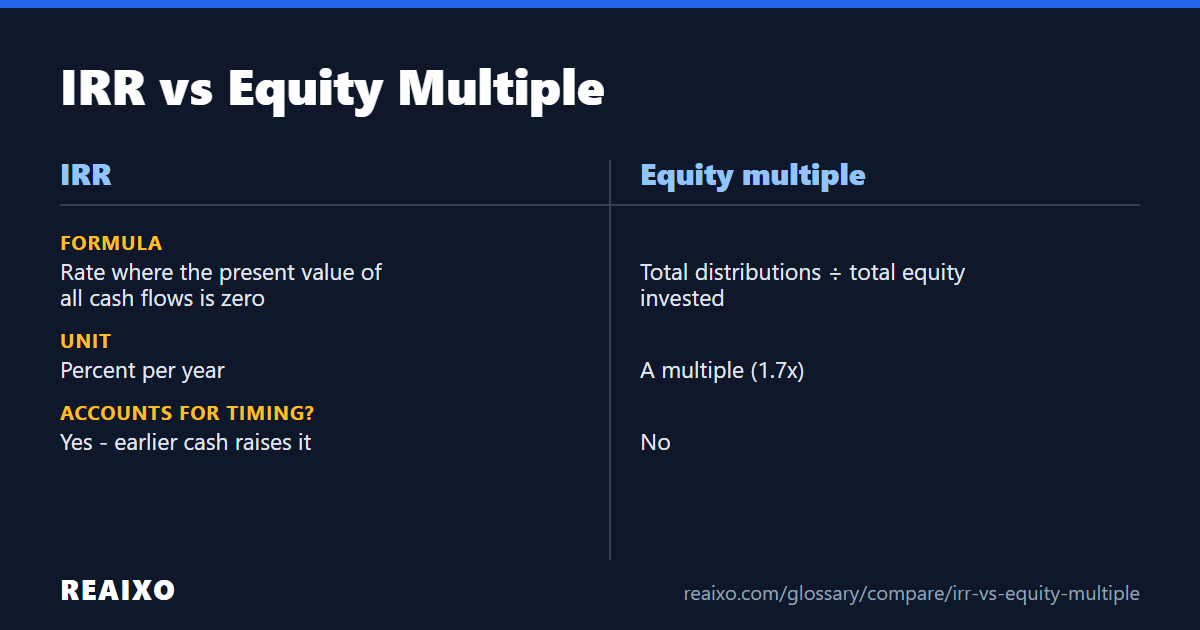
IRR vs Equity multiple side by side
| IRR | Equity multiple | |
|---|---|---|
| Formula | Rate where the present value of all cash flows is zero | Total distributions ÷ total equity invested |
| Unit | Percent per year | A multiple (1.7x) |
| Accounts for timing? | Yes - earlier cash raises it | No |
| Shows total profit? | No - a quick small gain can show a high IRR | Yes |
| Calculated by | Iteration (a solver) | Simple division |
| Typical use | Comparing deals with different timing; waterfall hurdles | Judging how much money a deal makes; investor reporting |
Full definitions: Internal Rate of Return, Equity Multiple.
When each one matters
Use IRR when timing differs - a deal that returns your money in three years leaves you free to reinvest, and IRR rewards that. Syndications also use IRR hurdles to decide when the sponsor's share of profits steps up.
Use equity multiple to see whether the profit is worth the effort and risk. A 25% IRR on a deal that returns 1.1x in five months makes very little money; a 2.0x multiple over five years doubles it.
How the calculations differ
- Equity multiple adds up every distribution - cash flow, refinance proceeds, sale proceeds - and divides by the equity contributed.
- IRR uses the same cash flows but discounts each by its date, solving for the rate that makes their present value equal the investment.
- Change only the holding period and the multiple stays the same while IRR moves; change only the sale price and both move.
Worked example
Same equity multiple, different holding periods
Illustrative example - round numbers, not current market data. Calculated with Reaixo's calculator engines.
Assumptions
- Equity invested
- $100,000
- Deal A
- $6,000 a year for 5 years, then $140,000 at sale
- Deal B
- $6,000 a year for 10 years, then $110,000 at sale
| Step | Calculation | Result |
|---|---|---|
| 1. Deal A equity multiple | $170,000 ÷ $100,000 | 1.70× |
| 2. Deal B equity multiple | $170,000 ÷ $100,000 | 1.70× |
| 3. Deal A IRR | solve NPV = 0 | 12.26% |
| 4. Deal B IRR | solve NPV = 0 | 6.73% |
Equity multiple (both deals): 1.70×. Both deals return 1.70× your money, but Deal A does it in half the time, so its IRR is 12.3% against 6.7%. The multiple tells you how much; the IRR tells you how fast.
What this calculation leaves out
- Equity multiple ignores timing entirely; always read it with the holding period or the IRR.
- Distributions are before the investor's own income taxes.
Common misconceptions
- A higher IRR always means a better deal. It can come from a small profit returned quickly.
- Equity multiple is an annual figure. It covers the entire holding period.
- Projected IRRs are as reliable as cash yields. Most of a projected IRR often comes from an assumed sale price.
Frequently asked questions
Which is more important, IRR or equity multiple?
Neither on its own. Read them together with the holding period: the multiple shows how much, IRR shows how fast.
Can a deal have a high IRR and a low equity multiple?
Yes. Returning a small profit very quickly produces a high IRR with a multiple only slightly above 1.0x.
Does equity multiple include the original investment?
Yes. It divides total distributions, including the return of capital, by the equity invested, so 1.0x means breaking even.
Calculators and guides
Recommended next step
Model cash flow, appreciation and the sale, and see both measures.
Project a deal's IRR and total return →Sources and review
No regulator defines these terms; the page follows common industry practice and labels rules of thumb as such.
Where this applies: Not regulated. Investment and valuation ratios are industry and appraisal conventions; analysts may define the inputs differently, so always check how a figure was calculated.
Last reviewed: · Updated:
Worked examples use illustrative round numbers, not current market data. Rates, limits and program rules change - confirm current figures with your lender or a qualified professional.
General educational information, not financial, legal, tax or real estate advice. Rules vary by loan program, transaction and location - verify important decisions with qualified professionals.