Contingent vs Non-Contingent Offer
A contingent offer makes the purchase depend on conditions - typically a satisfactory inspection, loan approval and an appraisal at or above the price - and lets the buyer cancel, usually keeping the earnest money, if one fails. A non-contingent offer waives some or all of those conditions. It is more attractive to sellers but shifts the risk to the buyer, who may have to cover an appraisal gap or lose the deposit.
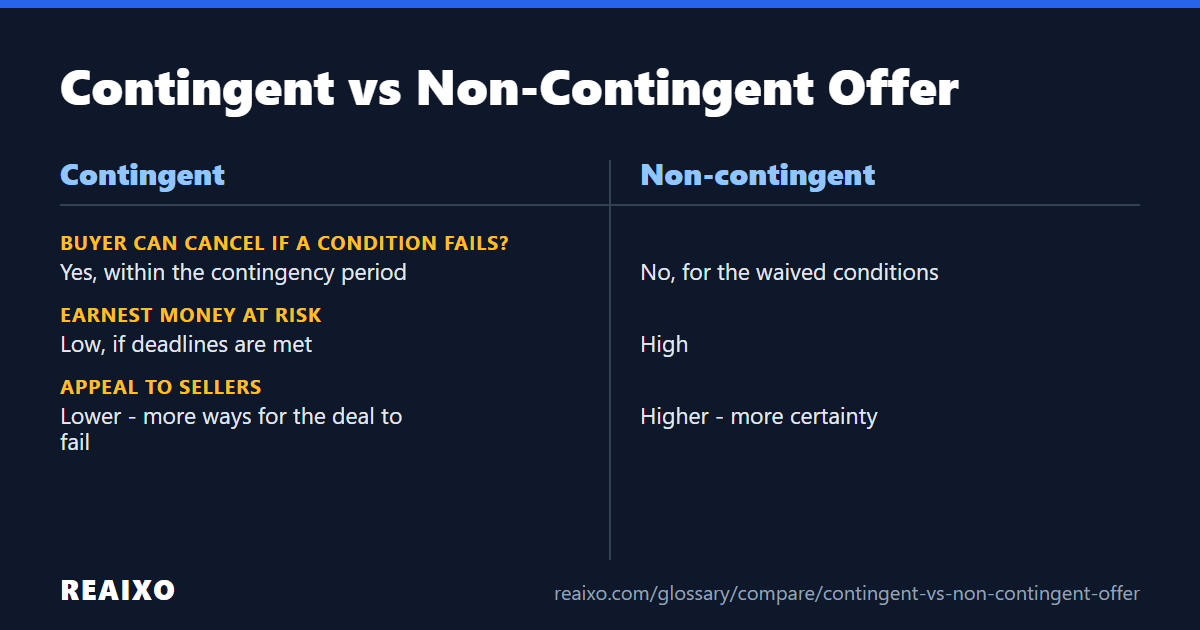
Contingent vs Non-contingent side by side
| Contingent | Non-contingent | |
|---|---|---|
| Buyer can cancel if a condition fails? | Yes, within the contingency period | No, for the waived conditions |
| Earnest money at risk | Low, if deadlines are met | High |
| Appeal to sellers | Lower - more ways for the deal to fail | Higher - more certainty |
| Low appraisal | Renegotiate or walk away | Buyer covers the gap in cash |
| Inspection problems | Request repairs, a credit or cancel | Buyer accepts the home as is |
| Best suited to | Most buyers, especially with limited cash | Buyers with cash reserves who have done due diligence first |
Full definitions: Contingent.
When each one makes sense
Contingencies are the default for good reason: they protect your deposit if the house, the loan or the appraisal does not work out. Most buyers, and anyone without spare cash, should keep at least the financing and inspection contingencies.
Waiving a contingency can win a competitive bidding situation, but only makes sense when you can absorb the risk - for example, a pre-inspection before offering, or enough cash to cover a low appraisal.
The money at stake
- Waived appraisal contingency: you may need cash equal to the contract price minus the appraised value, on top of your down payment.
- Waived financing contingency: if the loan fails, you may lose your earnest money.
- Shortened periods are a middle ground: keep the contingency but give yourself fewer days to act.
Worked example: covering an appraisal gap
A $20,000 appraisal gap with 20% down
Illustrative example - round numbers, not current market data. Calculated with Reaixo's calculator engines.
Assumptions
- Contract price
- $420,000
- Appraised value
- $400,000
- Loan program
- 80% LTV (no mortgage insurance)
| Step | Calculation | Result |
|---|---|---|
| 1. Appraisal gap | $420,000 − $400,000 | $20,000 |
| 2. Loan the buyer planned | $420,000 × 80% | $336,000 |
| 3. Largest loan at 80% of the appraisal | $400,000 × 80% | $320,000 |
| 4. Cash needed now (price − loan) | $420,000 − $320,000 | $100,000 |
| 5. Extra cash versus the plan | $100,000 − $84,000 | $16,000 |
Extra cash to close at the contract price: $16,000. To keep the price and stay at 80% LTV, the buyer needs $16,000 more cash. The alternatives are to renegotiate the price, split the gap with the seller, accept a higher LTV with mortgage insurance, or - with an appraisal contingency - cancel.
What this calculation leaves out
- Closing costs are extra and not shown.
- Whether the buyer can cancel and recover the deposit depends on the contract and its deadlines.
Common misconceptions
- Non-contingent means all-cash. A financed buyer can waive some contingencies and keep others.
- A contingent listing is off the market. Contingent (CTG) listings can often still take backup offers.
- Waiving the inspection contingency means skipping the inspection. You can still inspect for information; you just cannot cancel based on it.
Frequently asked questions
Is a non-contingent offer risky?
Yes, for the buyer. If the appraisal is low or the loan fails, you may have to bring more cash or lose your earnest money.
Which contingencies are most often waived?
It varies by market. Appraisal and inspection contingencies are commonly shortened or waived in competitive markets; financing contingencies less often.
What does contingent mean on a listing?
It means an offer has been accepted but conditions are still open. Many MLSs abbreviate it as CTG.
Calculators and guides
Recommended next step
See conservative, balanced and competitive offers and the cash each would need.
Build an offer you can afford to stand behind →Sources and review
No regulator defines these terms; the page follows common industry practice and labels rules of thumb as such.
Where this applies: United States. Contract terms, contingency periods and listing statuses are set by the purchase agreement, state forms and each MLS, and vary by market.
Last reviewed: · Updated:
Worked examples use illustrative round numbers, not current market data. Rates, limits and program rules change - confirm current figures with your lender or a qualified professional.
General educational information, not financial, legal, tax or real estate advice. Rules vary by loan program, transaction and location - verify important decisions with qualified professionals.